The Last Bit of Normal

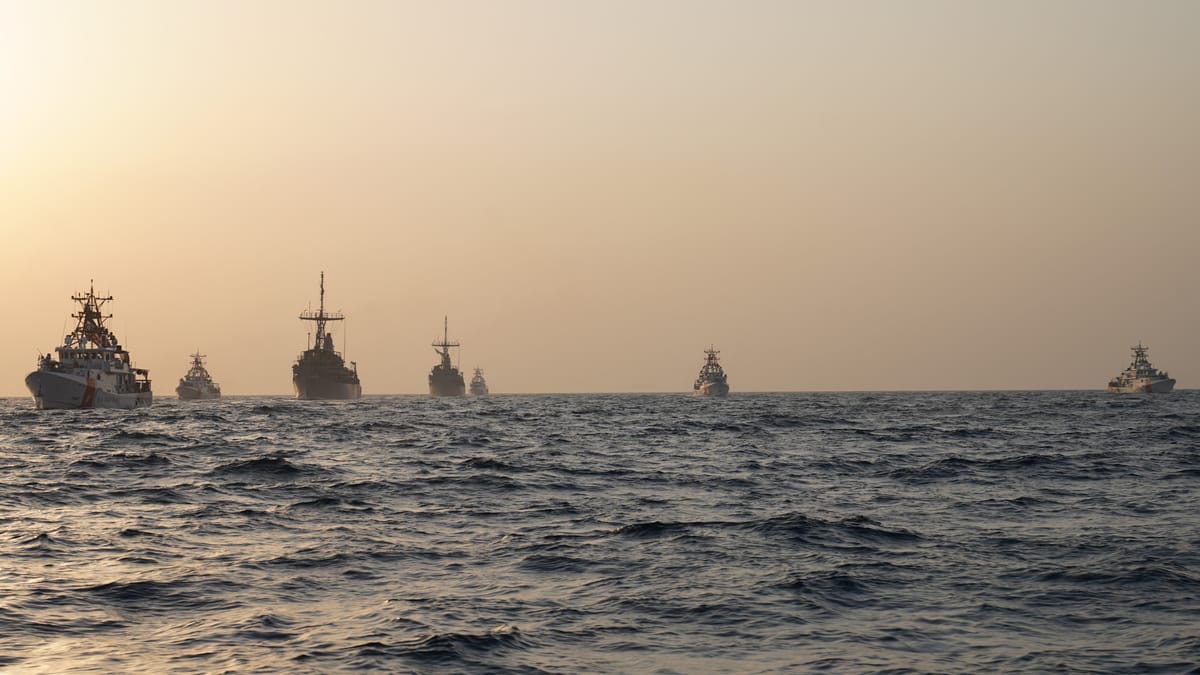
The Strait of Hormuz crisis may permanently change the world for a generation.
Sometime in the last three weeks, we passed through a door we are not going back through. Most people haven’t realized it yet. The groceries still show up. The lights still turn on. The commute seems to be the same. But the supply chains that make American normalcy possible are already breaking, and the damage is compounding by the day. This is the last stretch of normal, and we are wasting it by pretending otherwise.
On February 28, the United States and Israel launched Operation Epic Fury, a joint air and maritime campaign targeting Iranian military infrastructure, command and control centers, and ballistic missile sites.[1] The strikes killed Supreme Leader Ali Khamenei.[2] Iran retaliated with missile and drone attacks across the Gulf that hit U.S. military bases, Israeli territory, Saudi oil facilities, Qatari LNG terminals, and UAE energy infrastructure. The Islamic Revolutionary Guard Corps (IRGC) declared the Strait of Hormuz closed and began attacking commercial vessels.[3] Tanker traffic through the strait, a 21-mile-wide chokepoint that carries roughly 20 percent of the world’s oil and natural gas, has dropped by ninety percent almost overnight.[4]
This is a fundamental structural break from the status quo that cannot be walked back.
The Chokepoint
The Strait of Hormuz closure is already the largest disruption to global energy supply in history, exceeding the 1973 oil embargo and the 2022 shock from Russia’s invasion of Ukraine.[5] Brent crude, which sat at roughly $71 per barrel on February 27, has surged above $110 as of this writing.[6] Diesel in the United States topped $5 per gallon for the first time since 2022. Jet fuel costs are up 83 percent in a month.[7] European natural gas prices have nearly doubled.[8] The IEA has authorized the release of 400 million barrels from emergency reserves—a record—but that covers approximately twenty days of normal strait traffic. It’s a band-aid on a hemorrhaging wound.[9]
Iran did not need a naval blockade to achieve this. It did not need to mine the strait or deploy anti-ship missiles against armored warships. Cheap drones were enough to cause insurers and shipping companies to withdraw.[10] The de facto closure was accomplished through risk pricing rather than military dominance.[11] It was an asymmetric advantage that Iranian leadership had hoped would deter military intervention.
Even if the war stopped today, supplies would be disrupted for months. Every week it continues extends the disruption timeline in a nonlinear manner. If it lasts through the spring, we are looking at years of cascading consequences. The damage to Gulf energy infrastructure, from fires at UAE’s Shah gas field, strikes near Fujairah, and hits on Qatar’s Ras Laffan LNG complex, means that even reopening the strait does not immediately restore production capacity.[12] Iraq is shutting down oil fields because it has nowhere to store the crude it cannot export.[13] More than three million barrels per day of refining capacity in the region has already gone offline.[14]
The Cascade: From Energy to Everything
Oil prices and food prices move in lockstep. Energy costs feed into every stage of the food supply chain: fertilizer production, mechanized farming, refrigerated transport, packaging.[15] The global food system is built on natural gas in the form of nitrogen fertilizers. The Strait of Hormuz also serves as a fertilizer corridor, a food corridor, and a feedstock corridor for the global plastics and petrochemical industries.
The global supply of polyethylene and petrochemical feedstocks is also being disrupted at a scale that has no modern precedent. Cheap plastic, which is the essential building block of modern packaging, medical devices, food preservation, and consumer goods, also comes from the same fossil fuel supply chain that is currently on fire in the Persian Gulf.
We could see a sort of mini plastic age collapse as cheap plastic disappears from the market. Healthcare, food production, and manufacturing will all be irretrievably changed by this, even more so than by COVID. The pandemic disrupted logistics. This disrupts the feedstock itself. You cannot reroute a supply chain around a missing input.
If the disruption persists through June, it will hit the spring planting season in the Northern Hemisphere. Fertilizer shortages during planting do not produce a price increase in April. They produce a harvest failure in September.[16] The time delay between the disruption and its worst food-security consequences is measured in months. This means that by the time the crisis is visible on grocery shelves in the Global South, the damage will already be locked in.
The World Bank has already reported a 2.1 percent increase in its global Food Price Index for February, driven by vegetable oil and cereal price spikes, before the full effects of the Hormuz closure have propagated.[17] The Council on Foreign Relations has warned that the war-driven fertilizer shock could convert a regional military conflict into a global humanitarian crisis.[18]
This should sound familiar.
The Arab Spring Analog
A large part of what drove the Arab Spring was high commodity prices in the wake of the 2008 financial crisis, food shortages compounded by climate change in North Africa and the Middle East. In 2010 and 2011, a historic drought and heatwave in Russia slashed grain harvests and pushed global food prices to record highs, setting the stage for the uprisings that followed.[19] Egypt, then the world’s largest wheat importer, became ungovernable when bread prices spiked.[20] The Middle East and North Africa region spends more on food subsidies than any other because the social contract in these states is built on the government’s ability to keep staple foods affordable. When that contract breaks, everything breaks.
The food price instability we are about to see, coupled with fuel costs and the collapse of Gulf-dependent supply chains, will create the conditions for a reprise that is broader and more destabilizing as all food commodities will be affected, not just wheat. The US dollar will strengthen as a flight-to-safety asset, which means developing countries that need dollars to purchase fuel and basic food commodities will run out of purchasing power faster. We could see uprisings across the Global South, refugee crises, and a further surge in radical populism in Europe. These are all downstream consequences of an energy chokepoint that most Americans cannot find on a map.
The Medium-Term Outlook: Stagflation and Instability
We may be looking at a generation-long period of global instability where living standards substantially decline. That is not hyperbole. Every significant spike in oil prices in the modern era has been followed by recession.
Stagflation, the toxic combination of rising prices and slowing growth that defined the late 1970s, is no longer a theoretical risk scenario. It is becoming the current baseline. Central banks across Europe and Asia are already revising rate-cut expectations downward. Some are preparing to tighten. Higher borrowing costs will slow investment, suppress consumer spending, and make debt service more expensive for the countries least able to absorb it. The World Economic Forum has noted that for debt-laden Global South nations, this war is becoming a balance-of-payments crisis as much as an energy one.[21] A balance of payments crisis is what results in revolutions and collapses of governments.[22]
We may look back to the pre-COVID era as the halcyon days of a bygone world. The outlook is becoming increasingly bleak.
The Silver Lining: The End of Fossil Fuel Hegemony
Here is the one piece of genuine structural optimism in this catastrophe: this crisis will end fossil fuel hegemony, and it will do so faster than any climate policy could have ever hoped to achieve.
The Ember energy think tank has called this “Asia’s Ukraine moment.”[23] In 2022, Russia’s invasion of Ukraine forced Europe to confront its dependence on Russian gas and triggered the fastest renewable energy buildout in European history. Now Asia, which imports 40 percent of its oil through the Strait of Hormuz, faces the same reckoning, but with a critical difference: renewable energy technology is now cheaper and more mature than it was four years ago. Solar PV and onshore wind already generate electricity more cheaply than new coal or gas plants in most countries. Electric vehicles are increasingly cost-competitive with gasoline cars. The IEA has already cut its 2026 oil demand growth forecast and suggested that peak oil demand, previously projected for 2029, may already be here.[24]
Renewables will come out on top. Electrification will spike rapidly. Although, it will be difficult under stagflation as higher borrowing costs suppress the capital investment that renewable projects require. However, the strategic imperative is now overwhelming and governments may step in to directly provide financing to renewable energy projects at below market rates.[25] Every barrel of oil a country does not need to import through an unstable chokepoint is a barrel of strategic vulnerability eliminated. The logic has shifted from climate aspiration to national security necessity.
China understood this years ago, which is why it invested massively in renewables, nuclear, and EV manufacturing while diversifying its hydrocarbon suppliers and building enormous strategic reserves. That foresight is paying off now. The rest of the world will be forced to follow, not because of any green conviction, but because the alternative of perpetual dependence on a supply chain that can be shut down by cheap drones in a 21-mile-wide strait, is no longer tenable.
It will be at least a decade of pain. The transition will not be smooth or equitable. Capital will flow to electrification and away from fossil fuel infrastructure, but the timeline will be compressed and chaotic. We will come out the other side with substantially diminished emissions, reduced fossil fuel consumption, and a fundamentally different energy economy. On the way, millions will starve, be displaced, or die in conflicts downstream of this crisis.
Closing Thoughts
What I've laid out is not a very pretty picture.
Two weeks ago, I wrote that I hoped I was completely wrong about where this was heading. That hope is fading. The Strait of Hormuz remains effectively closed. Iran’s new supreme leader has vowed to maintain the blockade. Last night, Israeli strikes hit Iran’s South Pars gasfield, the largest in the world, and Iran has threatened to retaliate against energy infrastructure across the Gulf. The escalation spiral shows no sign of breaking.
What I want people to understand is that there is a lag between the disruption and the consequences. The gas station prices are the first-order effect. The food prices and shortages are second-order. The political instability is third-order. Each wave takes longer to arrive and lasts longer when it does. We are still in the first wave. The second is forming. The third will not crest for months.
This is the last bit of normal we may feel for a very long time.
[1] Cong. Rsch. Serv., R45281, Iran Conflict and the Strait of Hormuz: Impacts on Oil, Gas, and Other Commodities (Mar. 11, 2026), https://www.congress.gov/crs-product/R45281.
[2] Greg Myre et al., Iran’s Supreme Leader, Ayatollah Ali Khamenei, Has Been Killed, NPR (Feb. 28, 2026), https://www.npr.org/2026/02/28/nx-s1-5730158/israel-iran-strikes-trump-us.
[3] Greg Myre, How Traffic Dried Up in the Strait of Hormuz Since the Iran War Began, NPR (Mar. 4, 2026), https://www.npr.org/2026/03/04/nx-s1-5736104/iran-war-oil-trump-israel-strait-of-hormuz-closed-energy-crisis.
[4] Ciara Nugent, What Is the Strait of Hormuz and Why Is It at the Center of the Iran War?, Time (Mar. 17, 2026), https://time.com/article/2026/03/17/what-is-the-strait-of-hormuz-global-trade-oil-flow-iran-war/.
[5] Cong. Rsch. Serv., supra note 1 (describing the closure as the largest disruption in the history of the global oil market).
[6] Oil Prices Surge After Israeli Strike on Iran’s South Pars Gasfield, Al Jazeera (Mar. 18, 2026), https://www.aljazeera.com/news/2026/3/18/oil-prices-surge-after-israeli-strike-on-iran-gasfield-irans-threats.
[7] Lorie Konish & Greg Iacurci, Iran War, Oil Price Surge Worsen K-Shaped Economy, Say Economists, CNBC (Mar. 17, 2026), https://www.cnbc.com/2026/03/17/iran-war-oil-price-surge-worsen-k-shaped-economy-say-economists.html.
[8] Gas Prices Nearly Double as Europe Braces for Iran War Energy Shocks, Euronews (Mar. 3, 2026), https://www.euronews.com/business/2026/03/03/gas-prices-nearly-double-as-europe-braces-for-iran-war-energy-shocks (reporting Dutch TTF benchmark climbing from the low €30s to above €60/MWh within days of the conflict’s onset).
[9] Strategic Oil Release May Calm Markets but Cannot Fix Hormuz Disruption, Al Jazeera (Mar. 15, 2026), https://www.aljazeera.com/economy/2026/3/15/strategic-oil-release-may-calm-markets-but-cannot-fix-hormuz-disruption.
[10] Myre, supra note 3 (quoting Helima Croft, RBC Capital Markets: “All [Iran] had to do was several drone strikes in the vicinity of the Strait of Hormuz.”).
[11] U.S.-Iran Conflict: Strait of Hormuz Crisis Reshapes Global Oil Markets, Kpler (Mar. 1, 2026), https://www.kpler.com/blog/us-iran-conflict-strait-of-hormuz-crisis-reshapes-global-oil-markets.
[12] Sumi Sarma, Iran Targets UAE Energy Infrastructure as Gas Field Set Ablaze, Tanker Struck Near Strait of Hormuz, CNBC (Mar. 17, 2026), https://www.cnbc.com/2026/03/17/iran-war-uae-energy-gas-field-oil-fujairah-strait-of-hormuz.html.
[13] Myre, supra note 3 (reporting that Iraq is shutting down production in some of its largest oil fields because it has nowhere to store crude it cannot export).
[14] Nugent, supra note 4 (citing IEA data showing more than 3 mb/d of regional refining capacity offline).
[15] How Will Soaring Oil Prices Caused by Iran War Impact Food Costs?, Al Jazeera (Mar. 10, 2026), https://www.aljazeera.com/news/2026/3/10/how-will-soaring-oil-prices-caused-by-iran-war-impact-food-prices.
[16] Id. (noting that if the blockade persists through Q2 2026, the fertilizer shortage will begin to impact the Northern Hemisphere spring planting season).
[17] Global Food Prices Surge 2.1% as Geopolitical Volatility and Climate Risks Disrupt Agricultural Stability, FinancialContent (Mar. 16, 2026), https://markets.financialcontent.com/stocks/article/marketminute-2026-3-16-global-food-prices-surge-21-as-geopolitical-volatility-and-climate-risks-disrupt-agricultural-stability.
[18] Michael Werz, The Iran War’s Hidden Front: Food, Water, and Fertilizer, Council on Foreign Relations (Mar. 13, 2026), https://www.cfr.org/articles/the-iran-wars-hidden-front-food-water-and-fertilizer.
[19] Bram Govaerts & Sharon Burke, The Iran War Could Trigger a Global Food Crisis, Project Syndicate (Mar. 10, 2026), https://www.project-syndicate.org/commentary/strait-of-hormuz-closure-not-just-an-oil-problem-by-bram-govaerts-and-sharon-burke-2026-03.
[20] Id.
[21] The Global Price Tag of War in the Middle East, World Economic Forum (Mar. 2026), https://www.weforum.org/stories/2026/03/the-global-price-tag-of-war-in-the-middle-east/.
[22] Mia Wong, The Fake Crisis Behind Trump’s Tariffs, It Could Happen Here, iHeart, https://www.iheart.com/podcast/105-it-could-happen-here-30717896/episode/the-fake-crisis-behind-trumps-tariffs-326515712 (last visited Mar. 19, 2026).
[23] Kingsmill Bond et al., The Energy Security Fallout: From Fossil Fuel Fragility to Electric Independence, Ember (Mar. 18, 2026), https://ember-energy.org/latest-insights/the-energy-security-fall-out-from-fossil-fuel-fragility-to-electric-independence/.
[24] Id.
[25] Expert Comment: Could Oil Price Surge Accelerate the UK’s Shift to Renewables?, University of Oxford (Mar. 10, 2026), https://www.ox.ac.uk/news/2026-03-10-expert-comment-could-oil-price-surge-accelerate-uk-s-shift-renewables.