
In 2015, state legislatures across the United States considered 75 anti-LGBTQ bills, of which 27 targeted gender identity.1 In 2025, that total reached 1,059—with 851 of the current-session bills targeting gender identity.2 That is a more than fourteen-fold increase in total anti-LGBTQ legislation and a thirty-one-fold increase in gender identity-targeting bills in a single decade, with the steepest acceleration occurring after 2020. As of mid-March 2026, the LegiAlerts tracker already records 710 anti-LGBTQ bills—424 new and 286 carried over from 2025. Of the new bills alone, 350 target gender identity.3 Most state legislatures have not yet adjourned.
This is an industrialized campaign and the numbers tell the story with a clarity that requires no exaggeration.
filed in 2025
gender identity in 2025
in 2026 (ongoing)
enacted in 2025
I. The Trajectory
The raw escalation is exponential, not linear. The jump from 2022 to 2023 alone—from 285 bills to 678—represented more than a doubling.4 By 2025, the total reached 1,059. The passage rate has climbed in lockstep: 90 anti-LGBTQ bills were enacted in 2023, 64 in 2024, and 111 in 2025—the highest enactment year on record.5 And beginning in 2023, the campaign went federal. In 2022, Trans Legislation Tracker counted zero national anti-trans bills. By 2024, there were 88. By 2025, 113.6
Several things are immediately visible. First, the early trajectory shows fluctuation without sustained growth—a 2016 spike to 135 bills (driven largely by same-sex marriage and bathroom bills in the HB2 era) collapsed back below 100 within two years. Second, the inflection point was 2020–2021, when sports bans were deployed as the strategic wedge, driving the total from 123 to 261 in a single year. Third, from 2022 onward, every year has shattered the prior year's record, culminating in 1,059 bills in 2025—the sixth consecutive record-breaking year.7 The enactment rate tells the same story: from single digits through 2020, to 25 in 2021, to 90 in 2023, to a record 111 in 2025.
| Year | Bills Introduced | Bills Enacted | Federal Bills | Notes |
|---|---|---|---|---|
| 2015 | 75 | 5 | — | 27 targeting gender identity; bathroom-focused (HB2 era) |
| 2016 | 135 | 2 | — | 74 targeting GI; HB2 backlash dampens momentum |
| 2017 | 83 | 6 | — | 59 targeting GI; sports bans begin |
| 2018 | 74 | 2 | — | 32 targeting GI; healthcare bills emerge |
| 2019 | 62 | 2 | — | 28 targeting GI |
| 2020 | 123 | 3 | — | 88 targeting GI; sports as strategic wedge |
| 2021 | 261 | 25 | — | 222 targeting GI; sports bans become boilerplate |
| 2022 | 285 | 28 | 0 | 210 targeting GI; healthcare bans begin; "Don't Say Gay" |
| 2023 | 678 | 90 | ~53 | 604 targeting GI; more than doubled prior record |
| 2024 | 858 | 64 | ~88 | 463 targeting GI; 5th consecutive record |
| 2025 | 1,059 | 111 | ~113 | 851 of 1,049 new bills target GI; 6th consecutive record; 49 states |
| 2026* | 710 | 4 | — | 350 of 424 new bills target GI; session ongoing; 42 states |
II. What These Bills Actually Do
The LegiAlerts 2026 tracker categorizes anti-LGBTQ bills into functional types. The distribution reveals where the legislative energy is concentrated—and where it is expanding.
Gender-affirming care bans remain the single largest category at 76 bills, followed by sports bans (63), bathroom restrictions (49), laws to end legal recognition of trans people (47), and religious exemptions (29). But the breadth of the categories is itself the story. This is not a single-issue campaign. It targets healthcare, athletics, public facilities, legal identity, religious carve-outs, education, speech, performance, literature, family law, and online expression simultaneously. Birth certificate and ID change bans (18), pronoun bans (26), forced outing provisions (23), and drag bans (15) round out a legislative apparatus that touches virtually every dimension of trans and LGBTQ existence.
The "End Legal Recognition" category warrants particular attention. These are the so-called "sex definition" bills—measures that redefine "sex" across entire state legal codes as immutable and strictly binary from birth. Rather than targeting trans people domain by domain, they eliminate the legal category of transness itself. Multiple researchers have identified these as the most strategically significant development of 2024–2026:8 a meta-legislative move designed to circumvent the Supreme Court's 2020 holding in Bostock v. Clayton County9 that discrimination against transgender people constitutes sex discrimination under federal law.
III. The Asymmetry
The LegiAlerts 2026 tracker also counts pro-LGBTQ legislation: 509 bills, of which 359 are new and 150 are rollovers. On paper, this looks like a contested space. In practice, the asymmetry is overwhelming.
The LegiAlerts team's own note is telling: tracking pro-LGBTQ bills "tends to lag behind and is not complete" because they are "absolutely overwhelmed by anti-LGBTQ bills." The resource asymmetry is itself a datapoint about the strategic imbalance at work. Anti-trans legislation is produced at industrial scale by well-funded organizations providing model bills across jurisdictions. Pro-LGBTQ legislation is largely reactive—shield laws, nondiscrimination protections, conversion therapy bans—playing defense against an offense that grows faster than any defensive apparatus can match.
Of the 424 new anti-LGBTQ bills filed in the 2026 session, 350 explicitly target gender identity and 90 explicitly target sexual orientation. A staggering 371 target minors and 261 target adults. (These counts do not include the 286 rollover bills carried from 2025.) Trans people—an estimated 0.5% of the U.S. adult population10—bear a wildly disproportionate share of legislative hostility.
IV. The Escalation Pattern
What is structurally revealing about this campaign is not just its scale but its sequential logic. It follows a ratchet mechanism: each category of restriction, once normalized, becomes the platform for the next.
Bathroom bills (NC HB2) provoked backlash and economic costs. Republican operatives learned the lesson and chose sports as a more palatable entry point. American Principles Project president Terry Schilling later stated the strategy explicitly: women's sports was the issue that would get opponents "comfortable with talking about transgender issues."11
Sports bans proliferated in over a third of states,12 establishing the principle that trans people could be lawfully excluded from institutional participation based on assigned sex. More importantly, they normalized the legislative apparatus—model bills, testimony templates, committee structures—for processing anti-trans legislation at industrial scale.
The tripling of bills in 2023 was not spontaneous. It was the maturation of a coordinated infrastructure: the Alliance Defending Freedom and Heritage Foundation providing model legislation, state legislators copying bill text across jurisdictions, and a media environment where the political cost of targeting trans people had been systematically reduced. Categories multiplied: drag bans, book bans, forced outing, pronoun restrictions, child abuse reclassifications.
The emergence of "sex definition" laws represents a major shift. Rather than targeting policy areas one at a time, these bills redefine "sex" across entire state legal codes—making trans people's legal existence impossible across every domain simultaneously. This approach is designed to circumvent Bostock by attacking the category itself rather than any specific application of it.
V. The Impact
The Williams Institute at UCLA, analyzing laws enacted through the end of 2025, found:13
one restriction type
in restrictive states
restriction types
restrictions in 2025
More than half of all transgender youth aged 13–17 in the United States—382,800 young people—now live in states that have enacted one or more restrictions on healthcare, sports, bathrooms, or pronoun use. Over a third, 262,700, live in states that have enacted all four. Twenty-four states passed at least one type of new restrictive legislation in 2025 alone.
The federal dimension compounds this. Under the current administration, executive orders have banned trans people from military service, targeted hospitals providing gender-affirming care for defunding, investigated teachers for affirming trans students, and punished states with protective laws. The convergence of state legislative volume and federal executive action is historically unprecedented.
VI. Historical Context
There is no precise American precedent for a legislative campaign of this speed, scope, and coordination targeting a demographic group this small. But the numbers demand comparison to the legal architecture of prior civil rights rollbacks, even as the differences require careful acknowledgment.
To be clear at the outset: what follows is a structural comparison, not an equivalence. Jim Crow was a totalizing system of racial subjugation built on centuries of chattel slavery, enforced through mass violence, and maintained across every institution of American life for generations. The anti-LGBTQ legislative campaign, however severe, operates against a different historical backdrop and affects a differently situated population. The comparison is offered not to equate the two but to provide the only available American frame of reference for understanding legislative volume of this magnitude directed at a minority group.
The most commonly cited figure for Jim Crow legislation comes from the Falck catalogue, referenced by both the Brennan Center for Justice and the American Federation of Teachers: more than 400 Jim Crow state laws, state constitutional amendments, and city ordinances passed over the full century from Reconstruction to the civil rights movement.15
Now set the anti-trans legislative record alongside those figures. The rough cumulative total of anti-trans bills signed into law from 2015 through 2025 is ~298, depending on how carryover provisions and omnibus bills are counted. Very few passed before 2020. In 2022, the ACLU tracked a record-breaking 278 bills targeting LGBTQ people, of which 20 became law.16 Then the dam broke: 87 bills passed in 2023.17 In 2024, trackers recorded 701 bills across 44 states, with 51 signed into law in 17 states.18 By mid-2025, the ACLU was tracking 575 anti-LGBTQ state bills with 54 already enacted—a figure that rose to 111 by year's end, the highest single-year enactment count on record.19 2025 was the sixth consecutive record-breaking year, with legislation considered across 49 states.20
The honest analytical framing is this: in terms of rate, the anti-trans legislative campaign is operating at a pace that is comparable to or exceeds the catalogued Jim Crow legislative output when measured against the same timeframe. The Jim Crow system took decades to build to full intensity. The anti-trans legislative wave has gone from essentially zero to hundreds of enacted laws in approximately five years, metastasizing from a handful of bills targeting sports participation into a sweeping campaign against nearly every facet of transgender life—bathroom access, identification documents, medical care, education, employment, and in some proposals, the legality of transgender identity itself.21
Over the course of American history, 41 states enacted anti-miscegenation statutes—laws prohibiting interracial marriage, and in many states interracial sexual relations. At their peak in the late nineteenth and early twentieth centuries, 38 states had such laws on their books simultaneously.24 These statutes accumulated over a period of roughly 275 years, from Maryland's first anti-miscegenation law in 1691 through their invalidation in Loving v. Virginia in 1967.25 The total body of enacted anti-miscegenation law across all of American history amounts to approximately 41 state statutes.
Anti-sodomy laws, which were used to criminalize same-sex intimacy, were more widespread: as of 1960, all 50 states had anti-sodomy statutes on their books.26 By 1986, when the Supreme Court upheld Georgia's sodomy law in Bowers v. Hardwick, 24 states and the District of Columbia still maintained them. By 2003, when Lawrence v. Texas struck them down, 13 states retained active sodomy laws.27 The total body of anti-sodomy law: roughly 50 state statutes, accumulated over the colonial and national periods.
Now consider the anti-LGBTQ legislative campaign. In 2025 alone—a single calendar year—state legislatures considered 1,059 anti-LGBTQ bills, of which 111 were enacted into law.28 The number of anti-LGBTQ laws enacted in 2025 alone exceeds the total number of anti-miscegenation statutes that were ever on the books across all 41 states combined. It more than doubles the number of anti-sodomy statutes that remained active at the time of Lawrence. The cumulative total of enacted anti-LGBTQ laws now tracked in the LegiAlerts database stands at over 340, concentrated almost entirely in the period from 2021 to the present, which is a five-year window.
The sheer volume of legislation introduced is perhaps the most telling figure. The 1,059 bills considered in 2025 represent a legislative output that has no parallel in the history of American civil rights rollbacks. Even at the peak of massive resistance to Brown v. Board of Education, when Southern legislatures passed interposition resolutions, school closure laws, and pupil placement statutes to evade desegregation, the total annual volume of such legislation across all states did not approach four figures. The anti-abortion movement, the most sustained modern analogue, did not produce annual bill volumes of this magnitude even in the years immediately following Dobbs.
The closest structural parallels are not found in American history but rather abroad in authoritarian and autocratic regimes. The closest parallel being Russia. The pattern is a legislative campaign that begins with one plausibly defensible restriction, ratchets to adjacent domains, escalates to identity erasure, and converges with executive enforcement. This pattern maps more cleanly onto the early legislative phases of authoritarian consolidation against targeted minorities in other countries. The critical feature of this mechanism is the ratchet: each step normalizes the next, and the pace of escalation outstrips the capacity of courts, advocacy organizations, and affected communities to respond.
The 2026 data, even incomplete, confirms the trend has not yet plateaued. It has structurally solified. The question is no longer whether the ratchet will continue to turn. The question is what, if anything, will stop it and reverse the damage it has caused.
Credits
I want to thank the Legialerts team, Allison Chapman, Erin Reed, and especially Liz Saila whose work documenting and cataloguing all of this legislation made this analysis possible.
Notes
- Allison Chapman et al., Big Compilation Anti-LGBTQ Legislation Sheet, LegiAlerts.org, Summary tab (last visited Mar. 19, 2026), https://archive.legialerts.org [hereinafter LegiAlerts Compilation] (recording 75 total anti-LGBTQ bills in 2015, of which 27 targeted gender identity).
- Id. (recording 1,059 total anti-LGBTQ bills in 2025; of the 1,049 current-session bills, 851 targeted gender identity).
- LGBTQ+ Legislative Tracking 2026, LegiAlerts.org (last visited Mar. 19, 2026), https://tracker.legialerts.org (recording 710 total bills: 424 new, 286 carried over from 2025; of the 424 new bills, 350 target gender identity and 90 target sexual orientation).
- LegiAlerts Compilation, supra note 1.
- Id. (recording 90 bills enacted in 2023, 64 in 2024, and 111 in 2025).
- Trans Legislation Tracker, 2025 Anti-Trans Bills, translegislation.com (last visited Mar. 19, 2026), https://translegislation.com/bills/2025 (noting zero national anti-trans bills in 2022, 88 in 2024, and 113 in 2025).
- Trans Legislation Tracker, The Rise of Anti-Trans Bills, translegislation.com (last visited Mar. 19, 2026), https://translegislation.com/learn.
- Samantha Riedel, Anti-Transgender Legislation Accelerates in Early 2026, Prism Reps. (Feb. 9, 2026), https://prismreports.org/2026/02/09/anti-transgender-bills-2026/ (quoting researcher describing sex-definition laws as "a much more meta sort of approach" to redefining sex across entire state legal codes).
- Bostock v. Clayton County, 590 U.S. 644 (2020) (holding that Title VII's prohibition on sex discrimination encompasses discrimination based on transgender status).
- Jody L. Herman et al., Williams Inst., UCLA Sch. of L., How Many Adults and Youth Identify as Transgender in the United States? (June 2022), https://williamsinstitute.law.ucla.edu/publications/trans-adults-united-states/.
- Erin Reed, Over 850 Anti-LGBTQ+ Bills Filed in 2025; Most in History, Erin in the Morning (Apr. 18, 2025), https://www.erininthemorning.com/p/over-850-anti-lgbtq-bills-filed-in (quoting Terry Schilling, President, Am. Principles Project).
- Movement Advancement Project, Forecasting Equality: Expected Changes to LGBTQ Legislation in 2025 (Jan. 24, 2025), https://lgbtmap.medium.com/forecasting-equality-expected-changes-to-lgbtq-legislation-in-2025-cdc88636ead6; see also ACLU, Mapping Attacks on LGBTQ Rights in U.S. State Legislatures (2025), https://www.aclu.org/legislative-attacks-on-lgbtq-rights-2025.
- Williams Inst., UCLA Sch. of L., The Impact of 2025 Anti-Transgender Legislation on Youth 1–4 (Jan. 2026), https://williamsinstitute.law.ucla.edu/publications/anti-trans-legislation-youth/ (finding 382,800 transgender youth aged 13–17 live in one of 29 states that has enacted at least one of four key restriction types; 262,700 live in one of 16 states that has enacted all four).
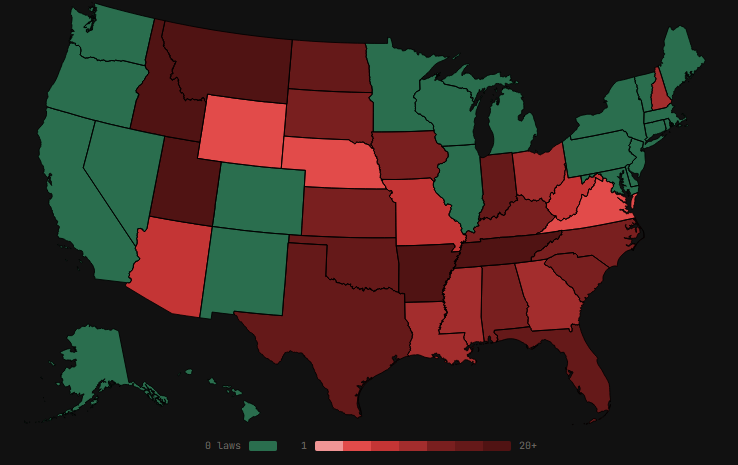
- New York, Minnesota, and Michigan are excluded from the map visualization. New York's single entry (2011) and Minnesota's entries (a 1997 same-sex marriage ban and a 2011 ballot measure that voters rejected) predate the modern anti-trans campaign and are not comparable to the post-2020 legislation. Michigan's 2025 entries (HR0040, a non-binding resolution) are excluded pending further verification of enacted law status. All three remain in the underlying LegiAlerts dataset.
- Am. Fed'n of Teachers, Jim Crow Laws, https://www.aft.org/ (citing the Falck catalogue of more than 400 Jim Crow state laws, constitutional amendments, and city ordinances passed from Reconstruction through the civil rights era); see also Brennan Ctr. for Justice, Jim Crow in New York, https://www.brennancenter.org/ (referencing the same catalogue).
- ACLU, Mapping Attacks on LGBTQ Rights in U.S. State Legislatures (2022), https://www.aclu.org/legislative-attacks-on-lgbtq-rights-2024 (tracking 278 anti-LGBTQ bills in 2022, of which 20 became law).
- Katharina Buchholz, Anti-Trans Bills Surged in Last Two Years, Statista (Nov. 20, 2024), https://www.statista.com/chart/33525/number-of-us-anti-trans-state-level-bills-considered/ (recording 87 anti-trans bills passed in 2023).
- Trans Legislation Tracker, 2024 Anti-Trans Bills, translegislation.com (last visited Mar. 20, 2026), https://translegislation.com/bills/2024 (tracking 701 bills across 44 states; 51 passed in 17 states).
- Orion Rummler, 2025 State Legislative Sessions, The 19th News (2025), https://19thnews.org/ (recording 575 anti-LGBTQ state bills by mid-2025 with 54 enacted at that point); LegiAlerts Compilation, supra note 1 (recording 111 total enacted by year's end).
- Trans Legislation Tracker, supra note 7.
- Reed, supra note 11.
- Brennan Ctr. for Justice, Voting Laws Roundup (2021–2022), https://www.brennancenter.org/our-work/research/voting-laws-roundup.
- Orion Rummler, Iowa Rescinds Trans Nondiscrimination Protections, The 19th News, https://19thnews.org/ (reporting that Iowa became the first state to completely rescind nondiscrimination protections for trans people).
- Equal Justice Initiative, A History of Racial Injustice: May 5, 1943, https://calendar.eji.org/racial-injustice/may/5 (noting 28 states had interracial marriage bans by 1861 and 7 more passed them before 1865; by 1948, 38 states still forbade interracial marriage); Jim Crow Museum, Ferris State Univ., Laws That Banned Mixed Marriages (May 2010), https://jimcrowmuseum.ferris.edu/question/2010/may.htm (noting marriage between whites and blacks was illegal in 38 states by the 1920s); see also Loving v. Virginia, 388 U.S. 1 (1967) (striking down anti-miscegenation laws in the 16 states that still maintained them; 9 states never enacted such laws).
- Loving v. Virginia, 388 U.S. 1 (1967).
- Cornell L. Sch., Legal Info. Inst., Lawrence v. Texas, https://www.law.cornell.edu/wex/lawrence_v._texas (noting that as of 1960, every state had an anti-sodomy law; by 1986, 24 states and D.C. still had them; by 2003, 13 states retained them).
- Lawrence v. Texas, 539 U.S. 558 (2003) (invalidating sodomy laws in 13 remaining states).
- LegiAlerts Compilation, supra note 1.