Exclusive: How The New York Times Changed Its Coverage of Trans People

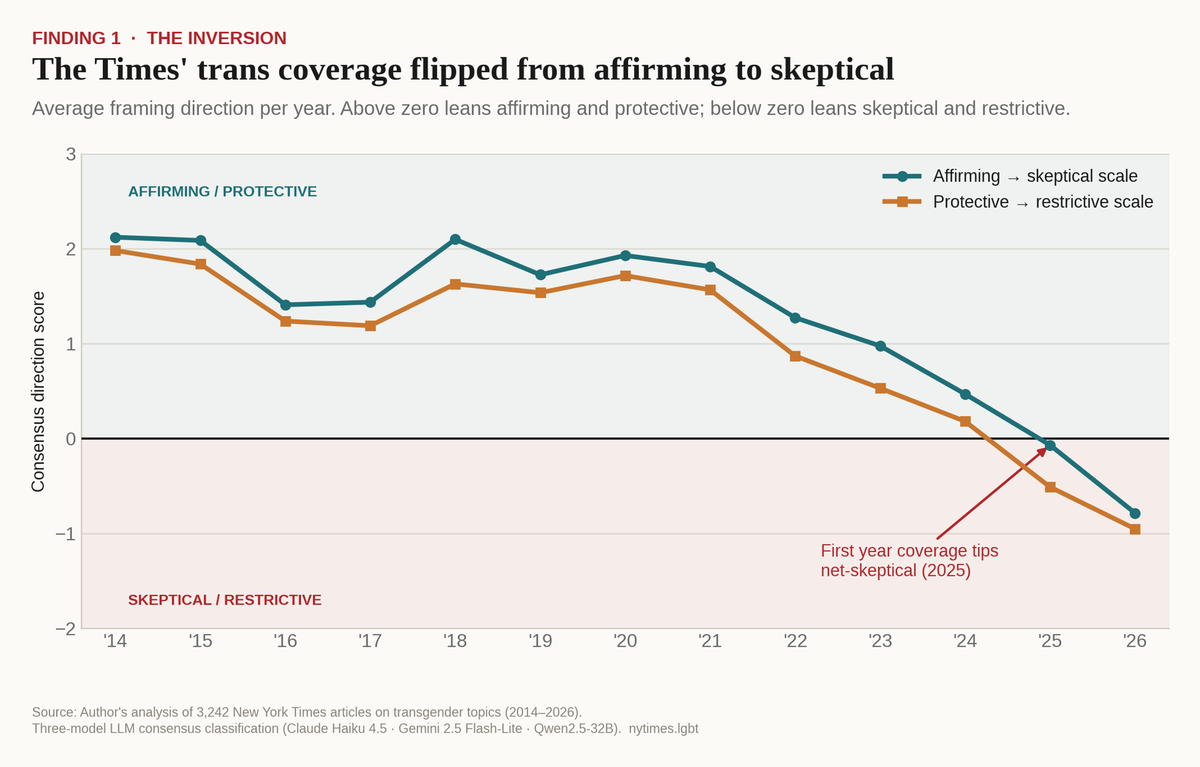
An exhaustive analysis of over 3,242 articles by the New York Times covering transgender issues from 2014-2026 revealed a stark shift towards hostile framing in 2022.
In January 2015, the New York Times’ only trans opinion columnist Jennifer Finney Boylan wrote an op-ed titled “How to Save Your Life”. The piece was written in the aftermath of the suicide of Leelah Alcorn. The piece was a powerful reminder of the difficulties that transgender people face in society and that transgender young people are among the most vulnerable. The piece ended with a quote from Alcorn’s suicide note stating: “Fix society. Please.”
This was a poignant article and an incredibly important piece of writing that allowed an openly trans opinion columnist at the most prestigious newspaper in the United States to share the last words of a transgender youth with the world as she pleaded for people to make society better. What was remarkable about this is that there was no issue at the time with a transgender opinion columnist doing so. By early 2022, this would no longer be the case.
In early 2022, the New York Times declined to renew Boylan’s contributing writer contract and thus left the paper of record. This left the Times without a highly visible trans voice. This was just one of the major changes that shifted how the New York Times would cover transgender issues starting in 2022 and would result in the reputation of the New York Times being tarnished with the transgender community.
The changes at the Times affecting the editorial focus are not limited to the lack of a renewal of the contract of a single writer. Around the same time in early 2021, A.G. Sulzberger became the chairman of The New York Times Company and in June 2022, Joseph Kahn was promoted to executive editor of the Times. In late 2021, health and science reporter Azeen Ghorayshi was brought on to focus on issues of transgender health care, particularly with regard to transgender youth. Pamela Paul was brought on to become as a columnist and would later become the most prolific when it came to publishing columns that were hostile to the idea of trans rights.
Over the last several years it has become readily apparent that there has been a shift in the editorial framing and focus of the New York Times when it regards issues relating to transgender people. This is particularly pronounced when it comes to issues of gender affirming care for transgender youth. The Times has contested this accusation of bias or editorial shifting of their priorities and framing, often by pointing to individual stories and claiming that the stories are rigorously fact checked and true. The issue is that any particular article can be argued about in isolation about whether or not the framing is biased against transgender people but when viewed in the aggregate the shift can become much more pronounced and difficult to defend.
While many organizations and activists before me have attempted to categorize and catalog the bias of the New York Times when it comes to transgender issues such as Assigned Media, GLAAD, Media Matters, and others, no one has fully analyzed the entire corpus of transgender coverage by the New York Times since 2014 to see exactly the nuanced changes in editorial focus and framing by the New York Times.[1]
The same paper that once gave a trans writer the page to argue for trans survival later treated that survival as an open question and let her contract lapse during the fight over how it covered her community. This shift in framing and coverage by the New York Times is measurable, and this piece measures it.
See the data and visualizations along with the detailed methods at www.nytimes.lgbt.
What I Did
Over the last few months, I utilized the Times’ API to pull the metadata for every single article relating to transgender issues since January 1st, 2014. This was done both through the Times’ own internal tag for transgender-related issues titled “transgender/transsexuals” as well as including a separate search through their articles API for a slew of trans-related terms that come up in coverage such as gender dysphoria, gender affirming care, and even hostile terms such as gender ideology. This resulted in a total of 3242 articles between January 2014 and early 2026. I subsequently utilized the metadata to be able to get the body text from archives in the Wayback Machine to be able to analyze the individual text of every article.
Once I had a corpus of all 3,242 articles written on transgender issues over a 12-year span, I was able to then run them through multiple LLM classifiers alongside a rubric to measure multiple dimensions of how each article framed its story and who it chose to center the story around. While many have reservations and reasonable concerns about the use of LLMs, language analysis is genuinely one of the useful use cases of this technology. Prior rules-based attempts such as natural language processing tools like VADER can't capture the nuance within individual stories to measure and analyze thousands of stories and millions of words over time. Thus, I used three separate models, Claude Haiku 4.5, Gemini 2.5 Flash-Lite, and the open-source Qwen 2.5 32B to individually score each article on a series of measures. Each individual score may not completely capture the totality of an article or even all of the nuance. However, once the data is aggregated, clear trend lines emerge.
What I Found
Measured across the entirety of the corpus of analyzed and classified articles, a clear directional trend emerged in the data showing that the New York Times coverage flipped from being affirmative and protective of trans rights to being skeptical and supporting restrictions on trans rights. This trend became increasingly clear starting in 2022.
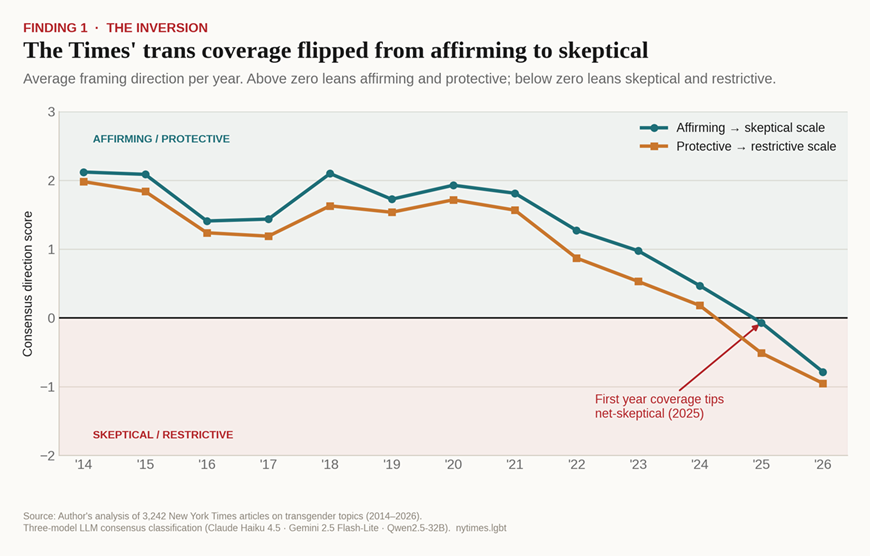
By early 2025, the coverage by the New York Times as a whole flipped from affirming and protective to skeptical and restrictive of trans rights. This followed an acceleration after the 2024 election where the paper sought through high-profile articles by Jeremy Peters and Nicholas Confessore to create the narrative that trans people brought the backlash on themselves rather than discussing the truth that this backlash was manufactured through hundreds of millions of dollars in spending by the far right with the explicit goal of pushing trans people out of society.[2]
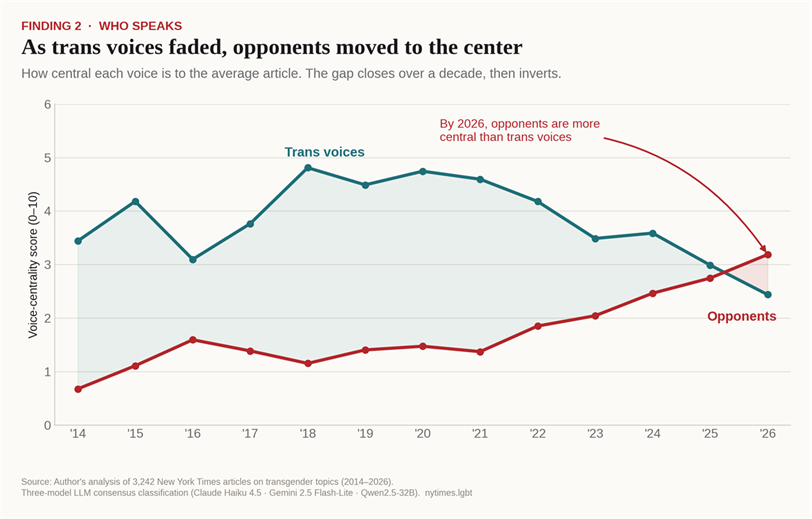
It wasn't just the framing direction of the articles themselves; it was also who got to speak in those articles. Prior reporting by Assigned Media and Media Matters has uncovered how often stories are about transgender people and never feature quotes by transgender people themselves.[3] Trans people are often spoken of but not to. The findings confirmed this as the analysis uncovered that as the framing direction changed the trans voices featured in articles declined substantially while the number of opponents of trans rights increased. By early 2026 this had completely flipped to where the voices of opponents of trans rights were featured more than the voices of trans people.
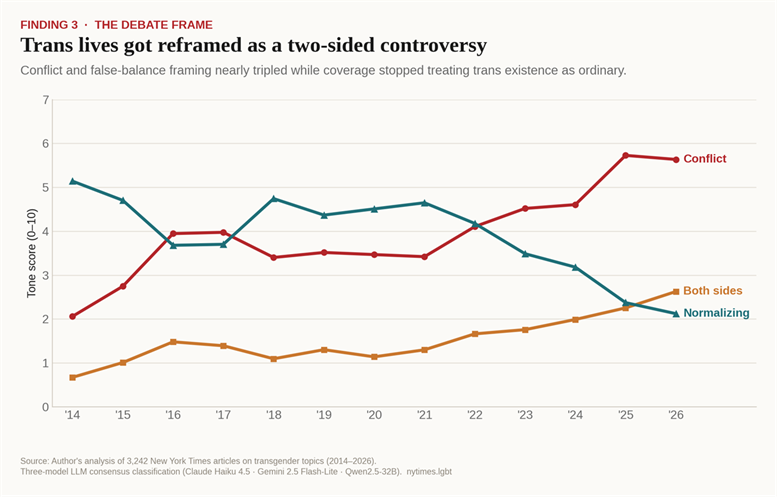
How transgender identity was framed within stories also changed substantially. Instead of being a normal aspect of society, transgender identity was reframed as being a conflict and resulting in a both-sides framing regarding the existence of transgender people. This type of framing has been a historical problem of the New York Times and how it covers minority communities whenever powerful political groups oppose their inclusion in a broader liberal and democratic society. The contributors’ letter in 2023 made this point explicit when it cited the history of the New York Times coverage of the gay and lesbian community from the 1960s through the 1990s. [4] This both-sides reflex by the New York Times has always resulted in a sense of shame over prior coverage and yet they willfully ignore when they are being told the damage their coverage is doing in real time.
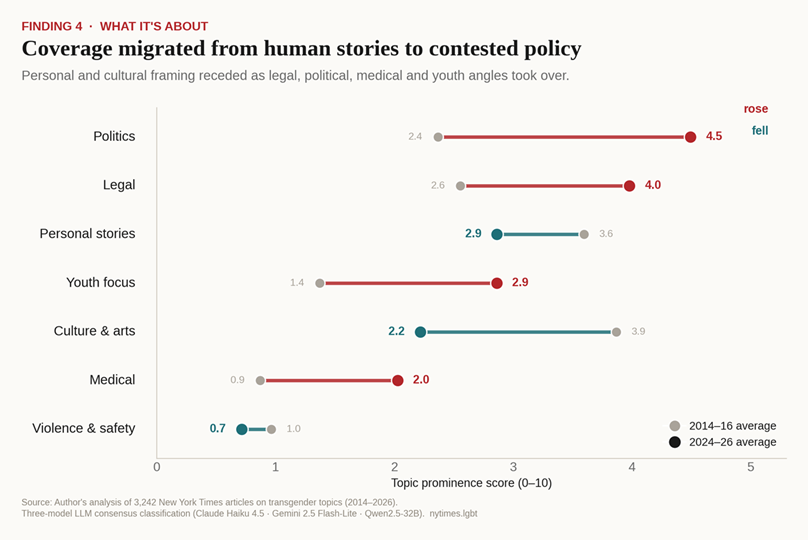
More so than the types of framing of stories and whose voices were included, the types of stories that were written about trans people changed. Personal stories regarding trans people, stories of trans people and broader arts and culture, and stories covering violence directed at the trans community all substantially declined. In their place came a deluge of stories covering politics, legal changes, a focus on transgender youth, and, in perhaps the biggest change, a focus on trans people's healthcare. This means that absent all of the changes in framing and voice selection, the average New York Times reader encountering a story about trans people would be less likely to see positive depictions of average people and instead would see stories focused on their health care, legal and legislative changes restricting trans rights, and politicians calling for the restriction of trans rights.
This change in story type was also accompanied by a change in how the rights of trans people were framed. From 2014 through 2021, the Times as a whole was generally supportive and affirming of trans rights. The editorial board was perhaps one of the most prolific voices in support of trans rights through this time frame. However, in 2022, this shift became readily apparent as stories emphasizing skepticism around gender affirming care and stories framing trans issues as a matter of culture war all dominated the coverage by the Times.
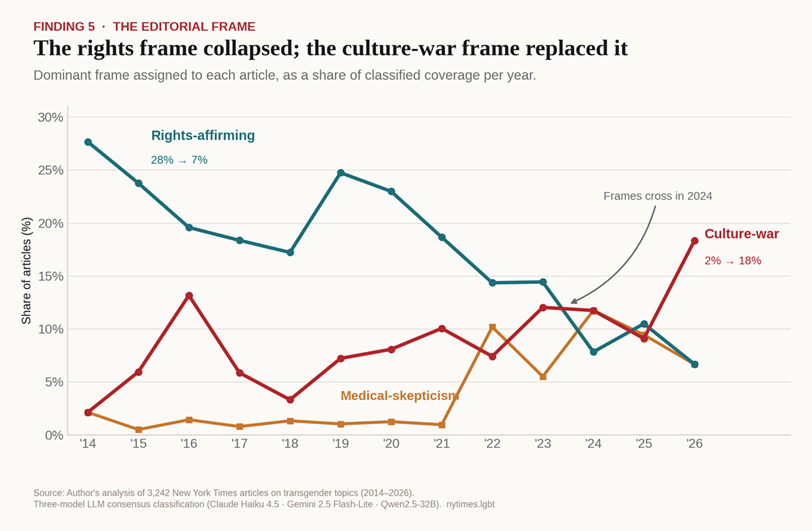
Finally, this transformation by the Times cannot be adequately discussed without mentioning the seismic shift in coverage surrounding gender affirming care for trans youth. This started with such stories as June 2022’s New York Times Magazine piece by Emily Bazelon titled “The Battle Over Gender Therapy,” which helped push into the mainstream the idea that gender affirming care for trans youth was a legitimate both-sides issue when in reality, the campaign to eliminate this type of care was pushed by Christian nationalist organizations and their fellow travelers.[5] This was quickly followed up by the New York Times assigning its star MeToo reporter Megan Twohey to cover the issue of puberty blockers for trans youth in a scandalous framing that was unsupported by the evidence. These two pieces ushered in an era where the Times sought to elevate critical voices while ignoring that those same voices were explicitly saying that they were utilizing the debate around gender affirming care for trans youth as a wedge to target the transgender community as a whole.[6] These pieces received substantial editorial investment along with priority front-page placement indicating the importance of these stories by the managing editors.
These one-off pieces were accompanied by a steady drumbeat of pieces that were framed in critical terms by Azeen Ghorayshi. Azeen sought to consistently place talking points utilized by SPLC-designated hate group SEGM, that Europe was so-called “pulling back” on care.[7] When the widely discredited Cass Review was released in the UK, Azeen provided a full interview along with a glowing profile.[8] What was omitted in their coverage were similar systematic reviews by the states in Utah, Louisiana, and countries such as Germany, Switzerland, and Austria that both undermined and contradicted the Cass Review.
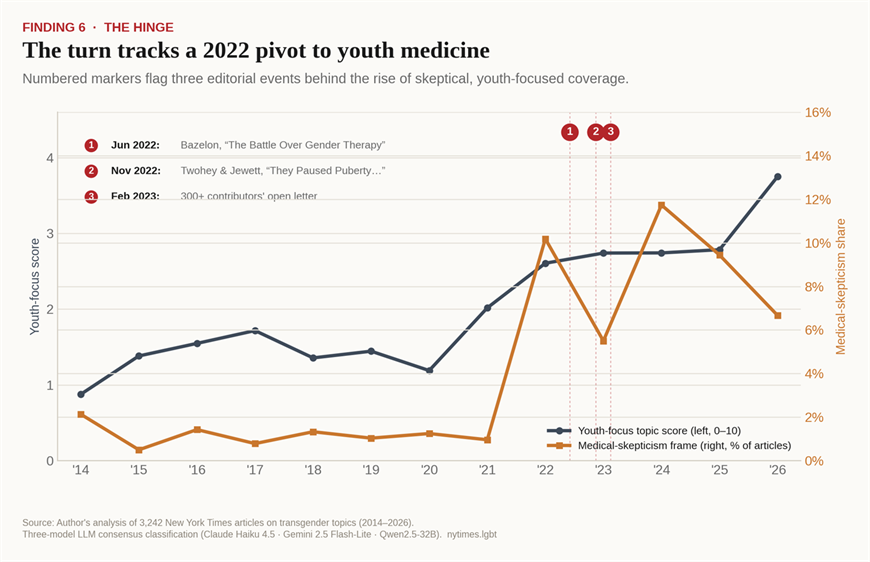
You can see this shift in coverage directly in the corpus data. In 2022, there was a substantial change to focus on transgender youth as a topic alongside a substantial increase in the proportion of stories covering their care in skeptical terms. Many of these stories often omitted or minimized the voices of transgender youth themselves.
Why This Matters
When the paper of record treats your existence as a debate, the framing does not stay on the page. The New York Times effectively sets the terms of what is considered respectable mainstream liberal opinion. What the Times treats as settled, the country treats as settled. What it frames as an open question shows up in courtrooms, in statehouses, in exam rooms, and in the minds of parents deciding whether to believe their own kids. I'm both a trans person and a lawyer. I have watched how the framing of these stories lands directly on people I know.
It is no wonder that Republican elected officials, Republican-appointed judges and Supreme Court justices, and far-right anti-trans hate groups have all cited the New York Times in their efforts to restrict transgender rights. The harm can be measured in the number of people forced to flee their homes and even their country as a result of these policies. As Howard Zinn once said, you cannot be neutral on a moving train. The New York Times chose to cynically change its framing and coverage around transgender issues in a bid to appeal to conservative voices. They did so knowing that the trans community was too small and politically powerless to effectively push back against the paper. And the organizations that did stand up would quickly be attacked by the Times itself through selective investigative reporting meant to silence criticism.[9]
In the short term, the New York Times has gotten away with it. As the rest of the media ecosystem is dismantled and repurposed by oligarchs in service of the MAGA agenda, the New York Times is one of the last bastions of old-school journalism that is still independent and at least tries to be on the side of fighting the Trump administration’s authoritarian moves. The New York Times has hit an all-time high subscriber count and their revenue is at all-time highs.[10] Thus any backlash from the trans community and their allies has had negligible impact on the Times’ bottom line. It hurts precisely the most because their cynical moves cost them nothing while it cost the trans community everything. Azeen Ghorayshi was promoted for her efforts and was heavily promoted by the Times for a Pulitzer Prize over her reporting, which parents of trans youth called “a betrayal.” They get to move on with their lives as trans people pick back up the pieces of theirs.
While I am certain with every fiber of my being that in the decades to come we will eventually see apologies and regrets by the Times over the types of coverage they engaged in, much as they’ve had to do for countless other historical mistakes, I want this article to be a record to independently show what happened, how it happened, and the effects it had on the trans community. They cannot be allowed to forget even if some may eventually choose to forgive. I, for one, don’t think I ever will.
[1] See The New York Times Fails to Include Trans Voices in Majority of Articles About Trans Issues, GLAAD (2023), https://glaad.org/the-new-york-times-fails-to-include-trans-voices-in-majority-of-articles-about-trans-issues/; see also Evan Urquhart, The New York Times Quotes Trans People Less Often Than Other Major News Outlets, Assigned Media (June 8, 2026), https://assignedmedia.org/breaking-news/new-york-times-trans-quotes-tracker/.; Vesper Henry & Ari Drennen, Seen but Not Heard: The New York Times Failed to Quote Trans People in over 60% of 2023 Stories on Anti-Trans Legislation, Media Matters for America (Mar. 26, 2024), https://www.mediamatters.org/new-york-times/seen-not-heard-new-york-times-failed-quote-trans-people-over-60-2023-stories-anti.
[2] Zane McNeill, Republicans Spent Nearly $215M on TV Ads Attacking Trans Rights This Election, Truthout (Nov. 5, 2024), https://truthout.org/articles/republicans-spent-nearly-215m-on-tv-ads-attacking-trans-rights-this-election/; Nicholas Confessore, How the Transgender Rights Movement Bet on the Supreme Court and Lost, N.Y. Times Mag. (June 19, 2025); see also Jeremy W. Peters, Transgender Activists Question the Movement’s Confrontational Approach, The New York Times, Nov. 26, 2024, https://www.nytimes.com/2024/11/26/us/politics/transgender-activists-rights.html.
[3] GLAAD, supra note 1 (finding that a majority of New York Times articles about transgender people quoted no transgender person); see also Assigned Media, https://www.assignedmedia.org (last visited June 19, 2026).
[4] Letter from New York Times Contributors to Philip B. Corbett, Assoc. Managing Editor for Standards, N.Y. Times (Feb. 15, 2023) (criticizing the paper’s coverage of transgender people and invoking its historical coverage of the gay and lesbian community). https://nytletter.com/
[5] Madison Pauly, Inside the Secret Working Group That Helped Push Anti-Trans Laws Across the Country, Mother Jones (Mar. 2023). https://www.motherjones.com/politics/2023/03/anti-trans-transgender-health-care-ban-legislation-bill-minors-children-lgbtq/
[6] Maggie Astor, G.O.P. State Lawmakers Push a Growing Wave of Anti-Transgender Bills, The New York Times, Jan. 25, 2023, https://www.nytimes.com/2023/01/25/us/politics/transgender-laws-republicans.html. (“The initial focus on children, he said, was a matter of ‘going where the consensus is.’); see also The Activist Who Persuaded Republicans to Target Trans Rights, NOTUS (2024), https://www.notus.org/the-influencers/terry-schilling-transgender-rights-american-principles-project (documenting the American Principles Project’s strategy of using transgender issues as a political wedge).
[7] Southern Poverty Law Center, SPLC Report Exposes Network Behind Junk Science and Disinformation Campaign Against the LGBTQ+ Community (Dec. 12, 2023), https://www.splcenter.org/presscenter/splc-report-exposes-network-behind-junk-science-and-disinformation-campaign-against/.
[8] Meredithe McNamara et al., The Integrity Project, Yale Law School, An Evidence-Based Critique of "The Cass Review" on Gender-Affirming Care for Adolescent Gender Dysphoria (2024), https://law.yale.edu/sites/default/files/documents/integrity-project_cass-response.pdf.
[9] Emily Steel, A Pattern of Lavish Spending at a Leading L.G.B.T.Q. Nonprofit, The New York Times, Aug. 1, 2024, https://www.nytimes.com/2024/08/01/business/glaad-ceo-spending.html. (investigating the spending of GLAAD’s chief executive, Sarah Kate Ellis).
[10] The New York Times Company, 2025 Fourth-Quarter and Full-Year Results (Feb. 4, 2026), https://s23.q4cdn.com/152113917/files/doc_news/2026/02/Q4-2025-Earnings-Release.pdf (reporting record subscribers and revenue).