What Hungary’s Election Actually Means for LGBTQ People


Breathing Room is not Liberation
On Sunday, Hungarian voters turned out in record numbers, the highest since free elections began in 1990, and handed Péter Magyar’s Tisza Party 138 of 199 parliamentary seats.[1] Viktor Orbán conceded by nightfall. The celebrations along the Danube were immediate, the international reaction euphoric. EU President Ursula von der Leyen declared that “Hungary has chosen Europe.”[2]
For LGBTQ Hungarians, the picture is grimmer than the fireworks imply.
What happened on Sunday was a regression to liberal democracy’s baseline: the restoration of an operating system in which courts function, institutions carry independent mandates, and civil society organizations can operate without being designated foreign agents. That matters. For a population that has spent sixteen years watching Orbán methodically dismantle every institutional check on executive power, it is the difference between drowning and treading water. Treading water is still not shore.
The Constitutional Architecture of Erasure
Most international coverage treats Orbán’s anti-LGBTQ campaign as a collection of discriminatory laws. However, it was a layered constitutional architecture, each component reinforcing the others.
In May 2020, parliament banned legal gender recognition for trans and intersex Hungarians entirely, redefining the Hungarian word “nem” (which means both “sex” and “gender”) as “biological sex based on primary sex characteristics and chromosomes,” immutable once recorded.[3] Trans Hungarians were thereafter forced to carry identity documents that did not match their appearance, their names, or their lived reality.[4] The Constitutional Court upheld the ban in 2023, creating a two-tier system: those who filed paperwork before May 29, 2020 could continue their legal process; everyone else was locked out.[5]
In June 2021, parliament passed the so-called “child protection” law, modeled on Russia’s 2013 anti-LGBTQ propaganda statute,[6] prohibiting the depiction or promotion of homosexuality or gender transition to anyone under eighteen.[7] The law triggered fines against bookstores, forced content ratings onto films and television, and created a regime of institutional self-censorship that pervaded Hungarian public life.
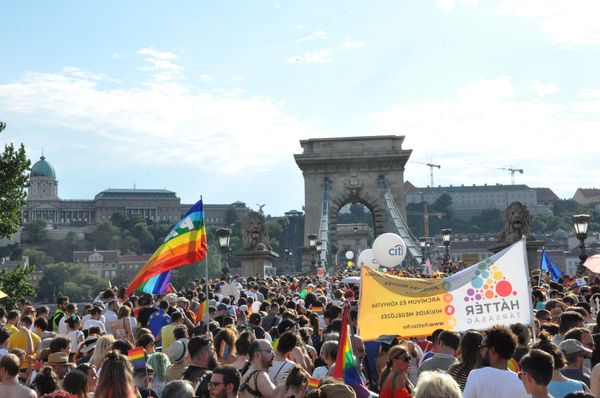
In March 2025, parliament banned Pride events and other LGBTQ public assemblies, authorized facial recognition technology to identify participants, and imposed fines up to 200,000 forints, with up to one year imprisonment for organizers.[8] Between 100,000 and 200,000 people defied the ban at Budapest Pride in June 2025, turning it into Hungary’s largest anti-government demonstration in years.[9]
In April 2025, parliament passed the Fifteenth Amendment to the Fundamental Law, which constitutionally codified the Pride ban, elevated children’s rights to “physical, psychological, and moral development” above all other fundamental rights except the right to life, and declared that the constitution recognizes only two sexes, male and female.[10] Dánel Döbrentey of the Hungarian Civil Liberties Union described the amendment’s purpose: exclusion of transgender and intersex people “not just from the national community, but even from the community of human beings.”[11]
Each of these layers was a fundamental part of the authoritarian project. Each reinforced the others. Most of it is now embedded in Hungary’s constitution.[12]
What Tisza Will and Will Not Do
Magyar’s posture on LGBTQ rights throughout the campaign was strategic silence. He refused to attend the 2025 Budapest Pride demonstration. He declined to denounce the Pride ban by name. His sole public statement on the issue was a generic defense of “the freedom of assembly,” calibrated to avoid handing Fidesz the culture-war provocation they were engineering.[13] Balkan Insight captured the logic precisely: Magyar followed “a strategy of not getting drawn into ideological, identity-politics related issues, in order to win the support of both liberal and conservative voters.”[14]
This strategy won him the election. It also tells LGBTQ Hungarians exactly where they stand in Tisza’s priority stack.
Magyar will restore the right of assembly. Pride events will proceed without police interference or facial recognition surveillance. The apparatus of active persecution will be dismantled. Háttér Society and other LGBTQ civil society organizations will operate without the threat of being designated sovereignty-threatening foreign agents.[15] These are material improvements in daily safety for LGBTQ Hungarians.
The constitutional architecture, however, remains intact. The 2020 legal gender recognition ban, the 2021 propaganda law, the 2025 constitutional amendments declaring a binary sex definition: all embedded in the Fundamental Law. Tisza holds 138 seats, a two-thirds supermajority that technically permits constitutional amendment. Whether Magyar will spend that political capital on LGBTQ constitutional provisions, when his coalition’s cohesion depends on conservative rural voters who backed Orbán’s anti-LGBTQ rhetoric for years, is answered by the campaign itself. He will not.
Trans Hungarians will not obtain legal gender recognition through Tisza’s legislative agenda. They will not be able to access gender-affirming healthcare because Magyar decides to champion their cause. The path runs through two slower, less certain channels: judicial reform that enables Hungarian courts to hear constitutional challenges to Orbán-era provisions, and European court proceedings that strike those provisions as violations of the European Convention on Human Rights and EU treaty obligations.
The European Litigation Pipeline
The litigation infrastructure already exists. Háttér Society has eighty-seven cases pending before the European Court of Human Rights challenging the legal gender recognition ban as a violation of Article 8 (right to private and family life).[16] The ECtHR has already found Hungary in violation of the Convention in Rana v. Hungary (2020), concerning a trans refugee denied recognition,[17] and R.K. v. Hungary (2023), finding that the absence of any legal gender recognition procedure breaches the Convention.[18]
In March 2025, the CJEU ruled in Deldits (C-247/23) that Hungary’s refusal to correct a trans refugee’s gender marker in national registries violated the GDPR’s accuracy requirements[19] and, critically, that surgical requirements for recognition violate Article 3 (integrity of the person) and Article 7 (private life) of the EU Charter of Fundamental Rights.[20] In March 2026, the CJEU extended this reasoning in Shipova (C-43/24), ruling that member states must provide legal gender recognition procedures for nationals who exercise free movement rights and that the complete absence of any LGR pathway is incompatible with the EU Charter and Treaty provisions.[21]
Hungary is already paying a daily fine of one million euros for refusing to implement CJEU asylum law rulings.[22] Orbán’s government also refused to implement the CJEU’s ruling requiring recognition of same-sex marriages concluded abroad. Whether a Tisza government will comply where Fidesz refused, and whether judicial reforms will produce Hungarian courts willing to apply European jurisprudence domestically, are the open questions.
The mechanism has legal force and has been advancing even under Orbán. The problem is that it moves in years, not months. Trans Hungarians who were locked out of legal recognition in May 2020 have now waited six years. The litigation pipeline suggests they will wait several more.
The Path Forward
Sunday’s result provides some room to breathe. They provide the conditions under which advocacy, litigation, and institutional reform become possible. The concrete priorities follow from the architecture of what Orbán built and the limits of what Magyar will voluntarily undo.
Tisza should repeal the 2025 assembly ban statute and decline to enforce the constitutional provisions codifying it, creating immediate legal certainty for Pride organizers and LGBTQ civil society.[23]
Judicial reform, specifically restoring the independence of Hungarian courts from Fidesz-era capture, is the precondition for every downstream constitutional challenge. Without independent courts willing to apply European jurisprudence, CJEU and ECtHR rulings remain paper victories that Hungary pays fines to ignore.
Tisza should comply with existing CJEU rulings (Deldits, Shipova, the same-sex marriage recognition mandate) as an immediate signal that Hungary intends to rejoin the European legal order.
LGBTQ organizations across Europe should treat Hungary’s election as a temporary opening in an ongoing continental struggle. The forces that built Orbán’s architecture are actively constructing the next iteration in Germany, France, Portugal, and Spain.
Breathing room is not liberation. It is the space in which liberation becomes possible. For LGBTQ Hungarians, the work is just beginning.
[1] Al Jazeera Staff, AFP & Reuters, Peter Magyar Wins Hungary Election, Unseating Viktor Orban After 16 Years, Al Jazeera (Apr. 12, 2026), https://www.aljazeera.com/news/2026/4/12/hungary-election-early-results-show-magyars-tisza-ahead-of-orbans-fidesz.
[2] Edna Mohamed, World Reacts to Peter Magyar Defeating Viktor Orban, Hungary’s Longtime PM, Al Jazeera (Apr. 12, 2026), https://www.aljazeera.com/news/2026/4/12/world-reacts-to-election-defeat-for-viktor-orban-hungarys-longtime-pm.
[3] Human Rights Watch, Hungary Ends Legal Recognition for Transgender and Intersex People (May 21, 2020), https://www.hrw.org/news/2020/05/21/hungary-ends-legal-recognition-transgender-and-intersex-people. The omnibus bill, Art. 33, replaced the category of “sex” on the civil registry with “sex assigned at birth,” defined as “biological sex based on primary sex characteristics and chromosomes.”
[4] TGEU, ILGA-Europe, IGLYO & OII Europe, Joint Statement, Hungary Rolls Back Legal Protections, Puts Trans and Intersex People at Risk (May 19, 2020), https://www.ilga-europe.org/press-release/hungary-rolls-back-legal-protections-puts-trans-intersex-people-at-risk/.
[5] Human Rights Watch, Hungary Court Closes Door on Transgender Legal Recognition (Feb. 9, 2023), https://www.hrw.org/news/2023/02/09/hungary-court-closes-door-transgender-legal-recognition.
[6] Act LXXIX of 2021 on Stricter Action Against Pedophile Offenders and Amending Certain Acts for the Protection of Children, § 6/A (Hung.) (amending the Child Protection Act to prohibit “making available to persons under eighteen” content that “depicts or promotes” homosexuality or gender transition); see also European Commission, Press Release, EU Commission Launches Infringement Proceedings Against Hungary Over Anti-LGBTIQ Law (July 15, 2021) (seventeen EU member states issued a joint declaration condemning the law as a breach of the Charter of Fundamental Rights).
[7] See David Vig, Statement on Behalf of Amnesty International (June 2021) (describing the law as having “dark echoes of Russia’s anti-gay ‘propaganda law’”) https://www.amnesty.org/en/latest/news/2021/06/hungary-proposed-law-a-new-full-frontal-attack-against-lgbti-people/; Fed. Law No. 135-FZ (Russ.) (June 29, 2013).
[8] How Hungary’s Pride Ban Tests the EU’s Commitment to Democracy, Verfassungsblog (Apr. 3, 2025), https://verfassungsblog.de/how-hungarys-pride-ban-tests-the-eus-commitment-to-democracy/ (analyzing the March 18, 2025 Assembly Law amendment, facial recognition authorization, and fine schedule); see also Hungary Passes Constitutional Amendment to Ban LGBTQ+ Public Events, NPR (Apr. 15, 2025), https://www.npr.org/2025/04/15/nx-s1-5365421/hungary-lgbtq-rights-ban-orban.
[9]Lavers, supra note 3 (reporting “[u]pwards of 100,000 people last June defied the ban and marched in Budapest’s annual Pride parade”). Organizers estimated attendance between 100,000 and 200,000.
[10] Fifteenth Amendment to the Fundamental Law of Hungary (Apr. 14, 2025) (amending Art. L(1) to define sex as binary, elevating children’s rights above all fundamental rights except the right to life, and constitutionally codifying the Pride ban); Hungary’s Parliament Passes Constitutional Amendment Banning Public LGBTQ+ Events, Euronews (Apr. 14, 2025), https://www.euronews.com/2025/04/14/hungarys-parliament-passes-constitutional-amendment-banning-public-lgbtq-events.
[11] Hungary Passes Constitutional Amendment to Ban LGBTQ+ Public Events, PBS NewsHour (Apr. 14, 2025), https://www.pbs.org/newshour/world/hungary-passes-constitutional-amendment-to-ban-lgbtq-public-events (quoting Dánel Döbrentey, Hungarian Civil Liberties Union).
[12] TGEU, Hungary Changes Its Constitution to Recognise Only Two Sexes: A Direct Attack on Human Rights (Apr. 15, 2025), https://tgeu.org/hungary-changes-constitution-to-recognise-only-two-sexes-a-direct-attack-on-human-rights/ (noting the amendment “clearly signals that Orbán’s government has no intention of implementing the recent CJEU ruling in the Deldits case”).
[13] Bea Bakó, Hungary’s Ban on Pride Has Little to Do with Being Gay, Balkan Insight (Mar. 27, 2025), https://balkaninsight.com/2025/03/27/hungarys-ban-on-pride-has-little-to-do-with-being-gay/.
[14] Zoltan Siposhegyi, From Insider to Rival: How Magyar Became Orbán’s Most Serious Challenger in 16 Years, Euronews (Apr. 11, 2026), https://www.euronews.com/my-europe/2026/04/11/from-insider-to-rival-how-peter-magyar-became-orbans-most-serious-challenger-in-16-years (“His position on LGBTQ issues is vague.”).
[15] Bakó, supra note 13 (noting Magyar “only commented on [the Pride ban] in a very general manner” and “condemned ‘the restriction of the freedom of assembly’ in general, without specifically mentioning Pride”).
[16] Interview with Eszter Polgári, Dir. of Legal Program, Háttér Soc’y, in Vues d’Europe (May 12, 2025), https://www.vuesdeurope.eu/en/court-of-justice-of-the-european-union-a-transgender-refugee-has-the-right-to-correct-his-gender-identity-in-the-hungarian-national-asylum-register/ (“We already have 87 cases pending before the ECtHR.”).
[17] Rana v. Hungary, App. No. 40888/17, Eur. Ct. H.R. (July 16, 2020).
[18] R.K. v. Hungary, App. No. 54006/20, Eur. Ct. H.R. (June 22, 2023) (finding that Hungary’s legal framework failed to provide “quick, transparent and accessible procedures” for legal gender recognition, in violation of Article 8); Háttér Soc’y, More Than 60 Transgender Hungarians Have Submitted Applications to the European Court of Human Rights (July 15, 2024), https://en.hatter.hu/news/more-than-60-transgender-hungarians-have-submitted-applications-to-the-european-court-of-human.
[19] Case C-247/23, Deldits, CJEU (Mar. 13, 2025); ILGA-Europe & TGEU, Joint Statement Welcoming EU’s Top Court Judgment (Mar. 13, 2025), https://www.ilga-europe.org/news/joint-statement-welcoming-eus-top-court-judgment-to-correct-applicants-gender-identity-data-in-national-registry/.
[20] See Trans* Rights Beyond Medicalisation? The CJEU in Case Deldits (C-247/23), Eur. L. Blog, https://www.europeanlawblog.eu/pub/gkdar607/release/2 (analyzing the CJEU’s reliance on Charter Arts. 3 and 7 and its departure from the prior medicalised approach to trans identity).
[21] Case C-43/24, Shipova, CJEU (Mar. 12, 2026); TGEU, Landmark CJEU Ruling Demands Member States to Ensure Legal Gender Recognition (Mar. 12, 2026), https://tgeu.org/joint-statement-landmark-cjeu-ruling-demands-legal-gender-recognition/.
[22] Polgári, supra note 16 (“We are already paying a daily 1 million euros fine for failing to follow the European asylum laws.”).
[23] See Verfassungsblog, supra note 8 (arguing the Pride ban “represents a clear departure from Hungary’s commitment to maintain and further the realisation of Human Rights and Fundamental Freedoms under the ECHR”).